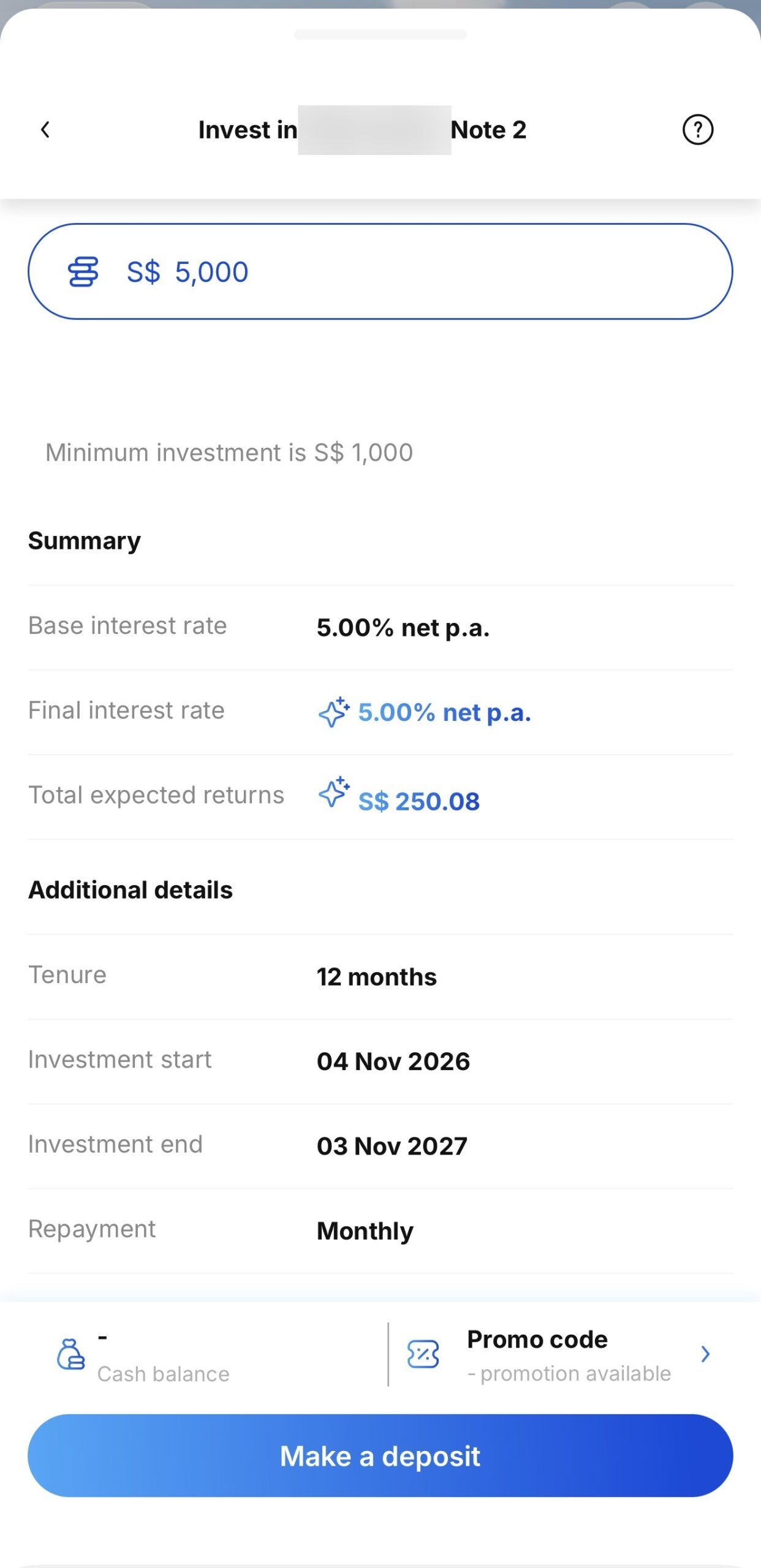

BigFundr is an investment platform licensed by the Monetary Authority of Singapore (MAS). It lets you lend money to companies that develop property projects, mostly in Australia. You earn a fixed interest rate over a loan period usually planned for 6-12 months. You can start with as low as S$1,000 in its Singapore-dollar (SGD) deals. As of October 2026, its current 12-month SGD notes pay 5% a year. This gives you a way to receive monthly interest in real estate investments without having to buy or manage a property yourself.
Who Is BigFundr, really?
BigFundr is fully owned by Maxi-Cash Capital Management Pte. Ltd., a company owned by Aspial Lifestyle Ltd. Aspial Lifestyle owns jewellery brands Lee Hwa and Goldheart Jewelry and is part of Aspial Corporation, whose shares are listed on the Singapore stock exchange (SGX). The wider group’s property developments include Australia 108 in Melbourne, developed by World Class Global.
How Does BigFundr Work?
BigFundr receives property-lending deals through fund managers in Australia. These are companies that manage investment money and arrange loans for property developers. Before listing an investment, called a Deal, on the app, BigFundr checks the borrower, the project and the property.
Once a Deal is listed on the app, you can read its factsheet to see the interest rate and when your money is due back. If you decide to invest, you can do so during the planned funding period, which is the period where the Deal is open for you to invest. When you confirm your investment, the amount is set aside from the money available in your account.
The Deal closes when its funding period ends or it has raised its target amount, whichever comes first. BigFundr buys loan notes on behalf of you and the other investors in the same Deal. You cannot take your money out early during the stated investment period.
Your money is held in a separate Deal Cash Account and released only after the Deal meets the conditions required by law, regulations and its contracts. Interest starts when the loan begins. The developer pays interest on the loan, which is where your return comes from.
How Does BigFundr Pay Out?
If you invest S$10,000 in a 12-month Deal paying 5% a year, you would earn S$500 in interest over the full year. That is about S$41.67 a month on average, assuming the loan runs for all 12 months and interest is paid as agreed.
The fixed interest is then added monthly to your BigFundr account. You can withdraw it to your own bank account, with a minimum withdrawal of S$20 for SGD. There are no additional platform fees for SGD investments, deposits or withdrawals through your own Singapore bank account.
Overview
| What | Detail |
|---|---|
| Minimum investment | S$1,000 for SGD deals; A$20,000 for Australian-dollar (AUD) deals; US$20,000 for US-dollar (USD) deals |
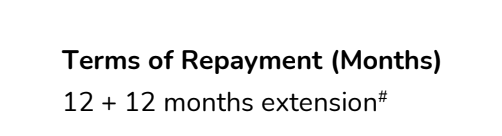
| Planned loan period | Usually 6 to 12 months, with up to 12 extra months to repay |
| Interest | Added monthly to your BigFundr account. Minimum per withdrawal: S$20 / A$200 / US$200 |
| Fees | No platform fees for SGD deposits, investments or withdrawals through your own Singapore bank account. Bank charges may apply for AUD/USD. |
| Early exit | You cannot take your money out early once it is invested in a deal |
Is BigFundr Licensed by MAS?
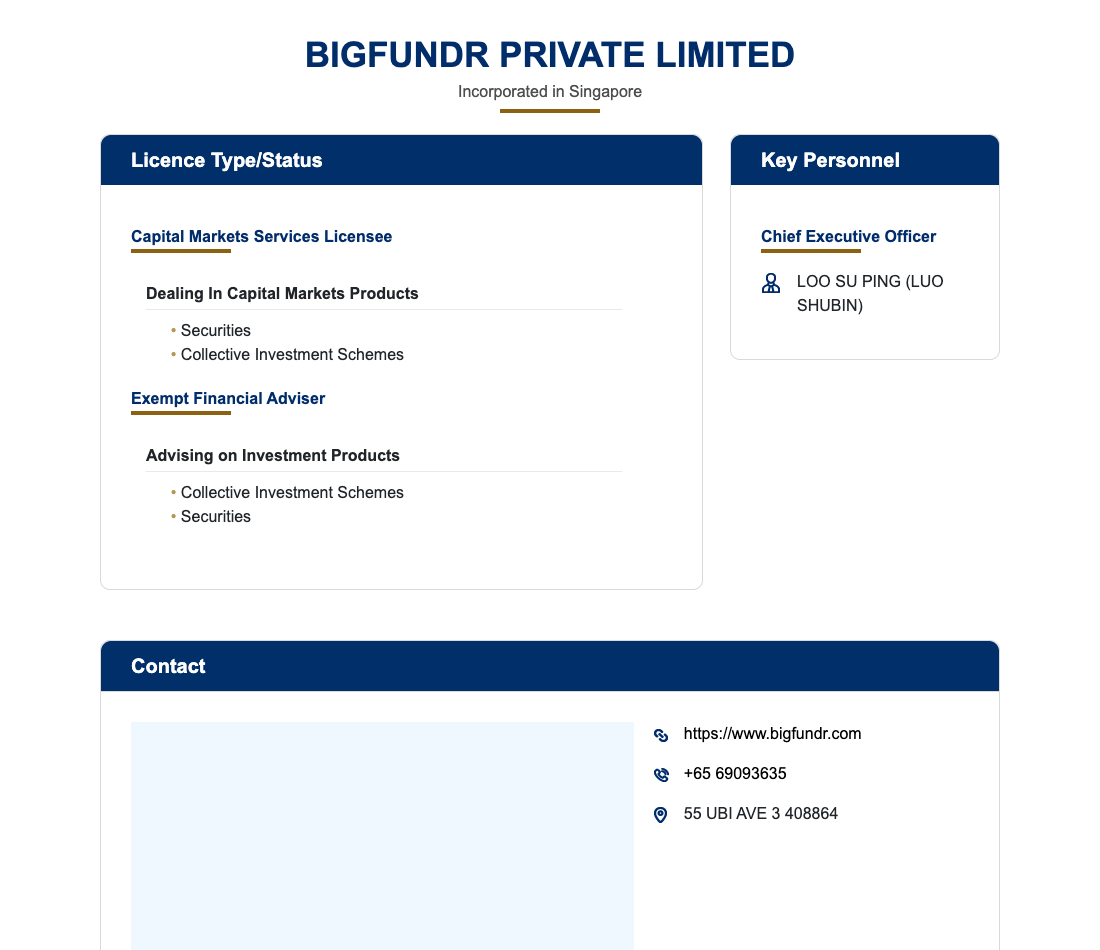
BigFundr Pte. Ltd. holds a Capital Markets Services licence from the Monetary Authority of Singapore (MAS) to deal in securities (investments such as loan notes) through its platform.

BigFundr notes are an investment. Your capital is at risk, and it is not insured by the Singapore Deposit Insurance Corporation.
What Should You Check Before Investing?
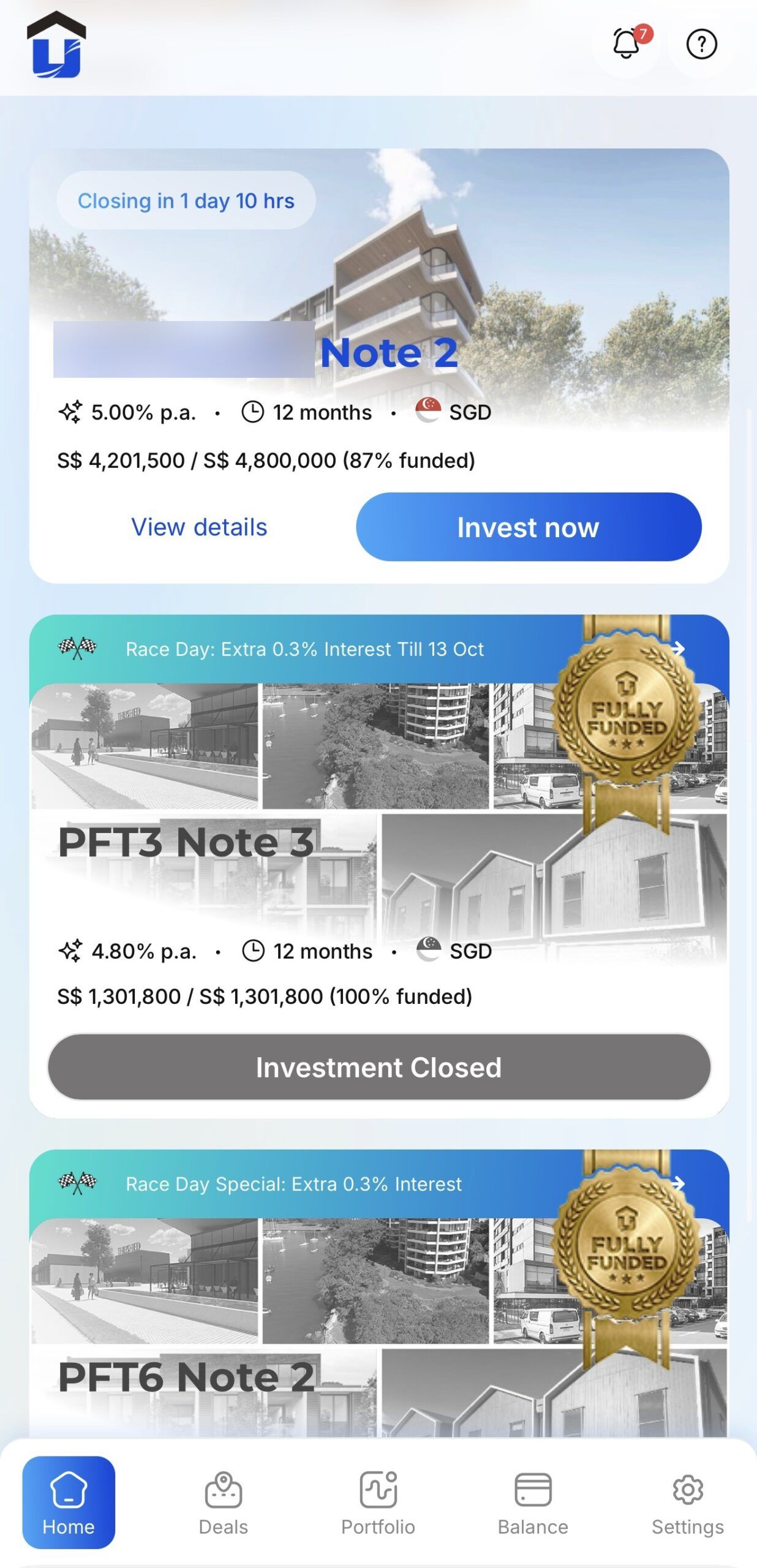
The app is where you will find all the available Deals. These Deals typically get funded within a week or less during its funding period. But before you invest, you need to understand the project your money will fund and the details of the deal.
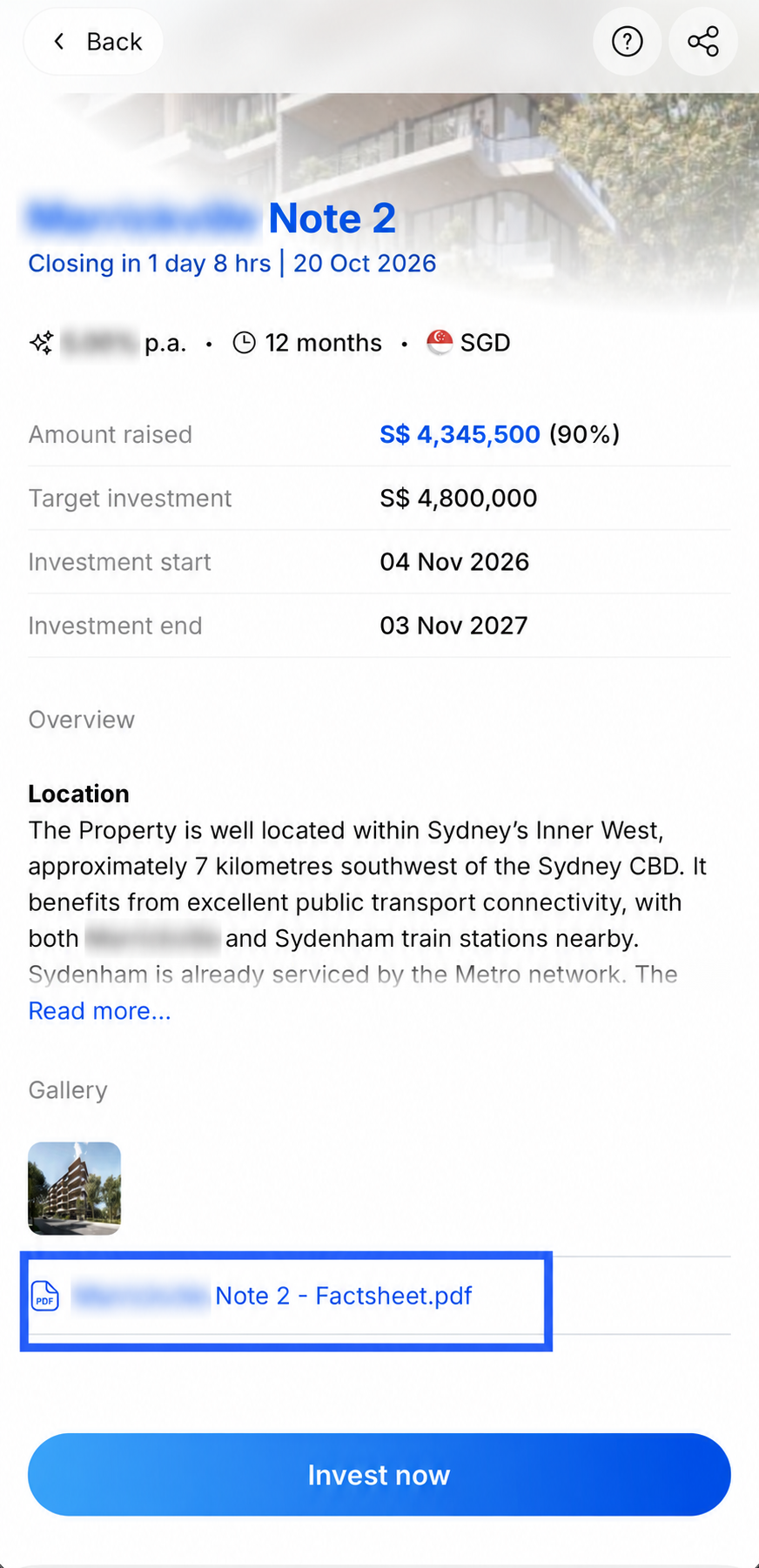
You can open a Deal in the app to find its factsheet, which explains the project and the conditions of the loan. You will also see the past Deals that have closed below, even though you won’t be able to see the factsheet once the Deal closes.

You can find the link at the bottom of the open Deal page, in the blue box shown below.

The Deal Factsheet Explained
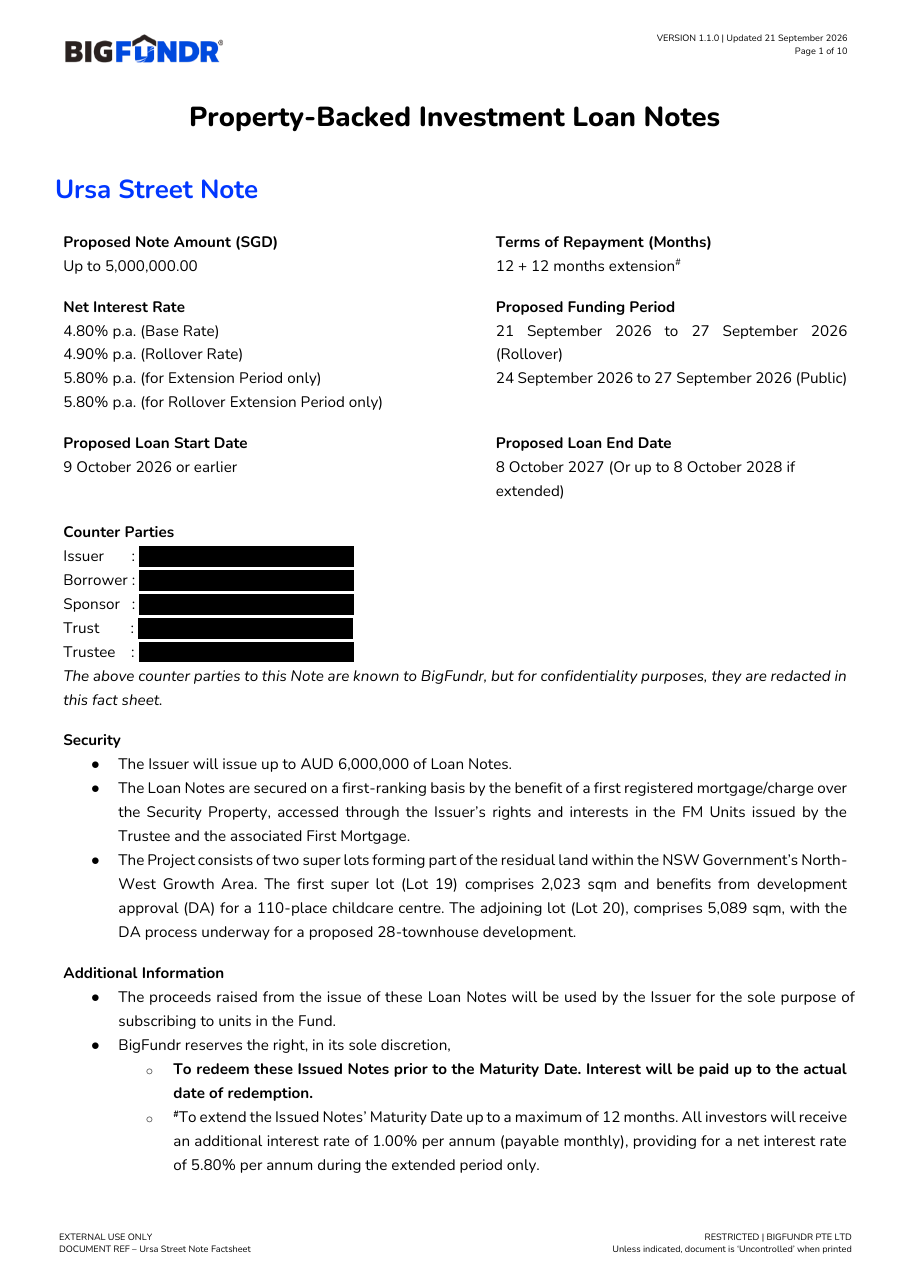
Let’s use the factsheet for a closed Deal called Ursa Street Note. Its 4.80% base rate differs from the current rate mentioned above.

How much interest will you receive?
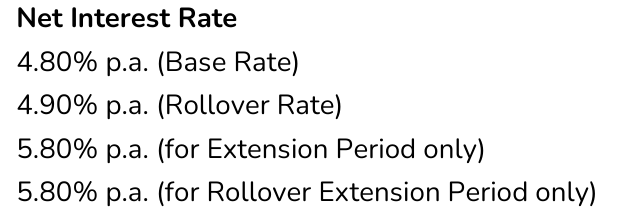
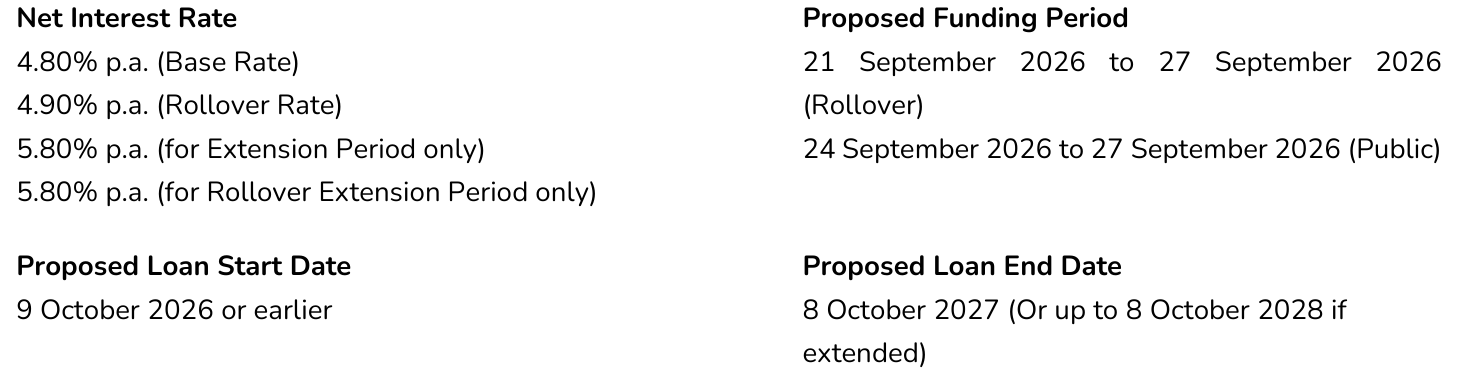
The Net Interest Rate section of Ursa’s factsheet shows the rates you receive after deductions, with different rates for the following situations:
- 4.80% base rate applies to new investors.
- 4.90% rollover rate is for existing investors who qualify and reinvest their principal, meaning the original money invested. They do this when an earlier note reaches its repayment date or is repaid early.
- 5.80% extension rate applies to both groups if Ursa’s loan is extended, meaning the borrower gets extra time to repay beyond the planned period.
With a rollover, you choose to invest your repaid money again. With an extension, the existing borrower gets more time to repay the same loan.

When does interest start, and when is repayment due?
The funding period is when a deal is open for investment on the app. Money you set aside to invest during this period earns no interest until the loan starts.
As you can see, Ursa’s funding period for the public was 24–27 September 2026. Its planned loan start date was 9 October 2026 or earlier.
The borrower, or developer may also repay early, in which case you receive interest only up to the redemption date, when the loan is repaid.

Which currency are you investing in?
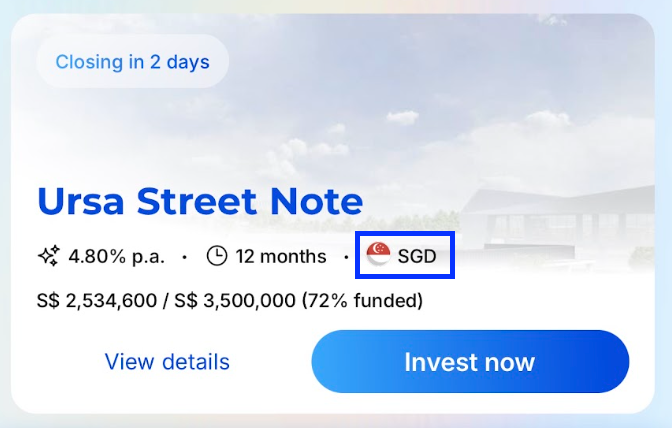
You should check the currency written on the Deal. In our example with Ursa Street note, you will see “SGD” on the Deal. This means that it is an investment in Singapore dollars. You invest in SGD, and you get paid in SGD. Even though it backed by a loan in Australian dollars, BigFundr says it fully hedges the currency exposure on that loan: it arranges protection against changes in the exchange rate between the currencies. Those movements therefore don’t change the SGD interest quoted to you.

For AUD and USD deals, BigFundr advertises up to 7% net a year (after deductions) as of October 2026. You deposit money and receive repayment in AUD or USD for these deals. If you convert the principal and interest back to SGD, their value will depend on exchange rates at the time. Do check the individual deal’s factsheet for its rate.
What is the property valuation based on?
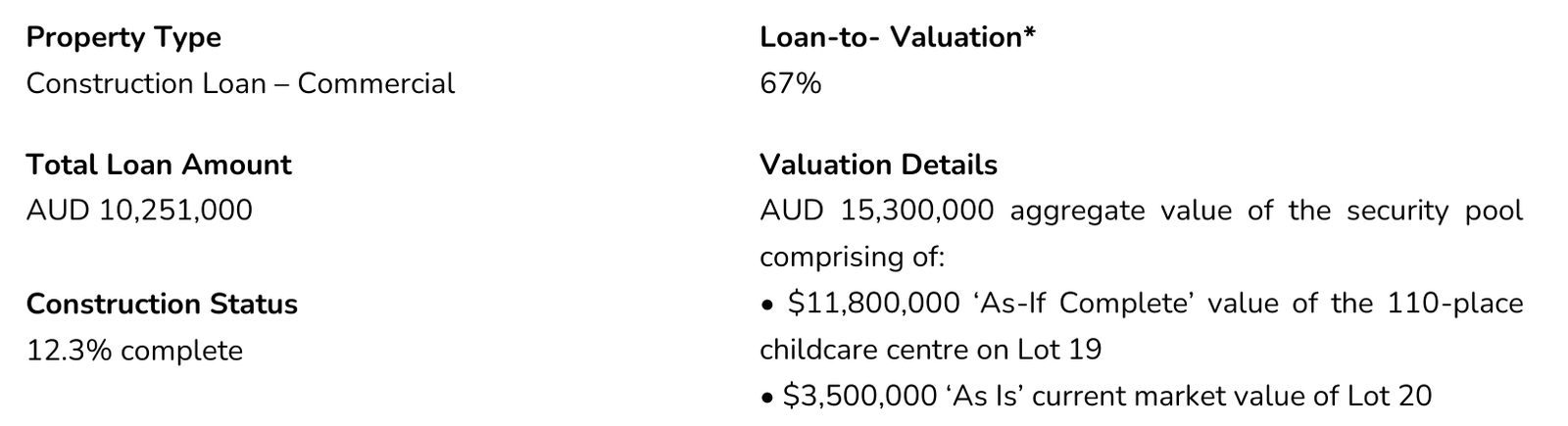
Loan-to-value (LTV) is the loan as a percentage of the property’s value. For example, borrowing S$670,000 against a S$1 million property gives an LTV of 67%. The gap between the loan and the property’s assessed value provides some protection if its value falls. BigFundr usually limits its loans to 70% LTV.
Ursa’s LTV is 67%, based on an A$10.251 million loan and an assessed property value, or valuation, of A$15.3 million. Of that valuation, A$11.8 million is the “as-if complete” value of a childcare centre, meaning what it would be worth once finished.

The childcare centre was 12.3% complete at the factsheet date, so its “as-if complete” value depends on the remaining building work being carried out.
How does the developer plan to repay?
The exit strategy explains where repayment is expected to come from. Refinancing means taking a new loan to repay an existing loan. For Ursa, the plan is to take two new loans: one for the completed childcare centre and another to fund construction of the future townhouses. Repayment in October 2027 therefore depends on the developer getting those new loans.

Who is involved in the deal?
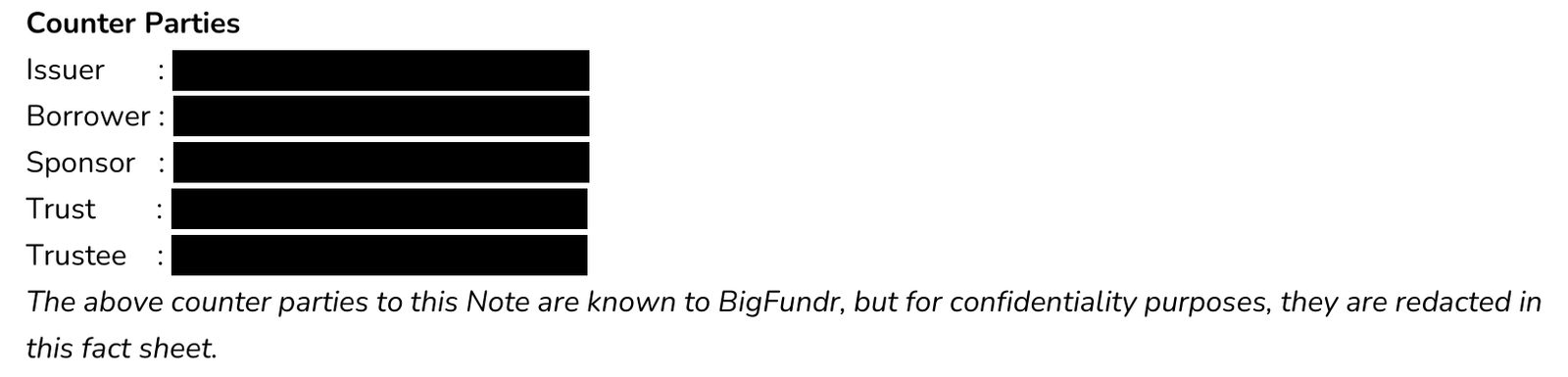
Ursa’s factsheet lists an issuer, borrower, sponsor and trustee. Their names are redacted, meaning hidden, and marked private and confidential. You can’t identify these parties from this document to look them up yourself, so you rely on BigFundr’s checks on the deal.

Those checks take place before a deal is listed: BigFundr’s credit assessment team, which assesses lending risk, and its investment committee review the borrower and project. Legal and property checks confirm that the property is genuine, who owns it and what it is worth. Money is held in a separate cash account for the deal and released only once the conditions required by law, regulations and the contracts are met.
Common Questions That An Investor Would Ask
What happens if the developer cannot repay?
If the developer cannot repay, money may be recovered from the property. The fund holds a first mortgage on the property, so it can claim that money before lenders with lower priority.
The borrower’s personal or corporate guarantee can also be used to seek any money still owed. This is a promise by a person or company, called the guarantor, to repay.
Where a Deal includes a buy-back provision, this condition requires the Australian fund manager to buy back the loan on a set date.
For its lending history, BigFundr reports zero non-performing loans (NPLs), using its own classification, for its 2021–2025 lending years. Its statistics page measures each year’s loans at 31 December of the year the loan money was paid out. Each figure therefore describes loans made that year as measured at that year-end. You can find this method under “Statistics” on BigFundr’s website.
What if property prices fall?
At 70% LTV, a completed property valued at S$1 million backs a S$700,000 loan. Suppose the developer owns the property and this is its only debt. The S$300,000, or 30%, is the developer’s own stake: the value left for the developer after subtracting the loan.
In this example, a fall in property value reduces the developer’s stake first. The property would need to lose more than 30% of its value to be worth less than the S$700,000 loan principal. Having their own stake at risk also gives developers a financial reason to complete the project and repay the loan as planned.
For context, Sydney home prices fell 13.8% from January 2022 to January 2023, according to CoreLogic data reported by St.George. That decline was smaller than the 30% gap in this example. However, it does not tell us how this particular development would perform, especially while construction is unfinished.
What if construction or refinancing is delayed?
A late build can delay the sale or refinancing needed to repay the loan. If repayment is delayed, the loan is automatically extended, giving the borrower up to 12 additional months to repay.
During this extra repayment period, BigFundr’s general terms describe an extra 1% a year in interest. Check your factsheet for the extension rate that applies to your deal; your money stays invested in the loan during this period.
According to BigFundr, it has never had to extend a loan this way.
What happens if BigFundr closes down?
Cash you have not invested is held in escrow, an account kept separate from BigFundr’s own money and property. BigFundr appointed Vistra Pte Ltd as its independent cash administrator, which handles customer cash, and DBS as its banking partner. Keeping customer cash separate is intended to allow it to be returned if BigFundr stops operating. Money already invested in loans still depends on those loans being repaid.
Is the Interest Taxable?
The interest earned through its platform is currently not taxable under Singapore law for Singapore residents. Non-residents may face withholding tax, meaning tax deducted before the interest is paid to them.

My Take
BigFundr is one alternative for those who are interested in real estate investments to earn a higher yield with a monthly payout at a fixed interest rate. I would only consider using money that I want to invest and won’t need for at least 24 months, with my emergency fund kept separate.
Spreading your investment across different projects may help limit how much of your money is affected by one project’s delay.
What I Did Personally
For my own investment, I looked at BigFundr’s lending history and spoke to the management team. I also studied the Aspial Corporation annual reports, which explain its business and finances, on my own. I felt confident enough to try the platform with a small initial sum in a particular Deal that is now closed to investment. I used money I had available to invest and won’t need in the next 12–24 months.
I am sharing this for educational purposes, and this article is not sponsored. It is not a recommendation to buy, sell or hold an investment. You should do your own research before investing.
How to Sign Up
Step 1 — Download the BigFundr app and sign up. If you’d like to use my referral code, enter R70247F when signing up. If you miss this step, you can still add a referral code within 30 days of signing up.
R70247F
- Download the app from the App Store or Google Play
- Copy the referral code above and enter into the app when prompted
- Sign up with your details
Step 2 — Verify your identity. Use Singpass MyInfo, or upload a passport, work pass and proof of address if you’re a foreigner without Singpass.
Step 3 — Complete the suitability assessment. This checks whether the investment suits you. BigFundr says account verification normally takes up to 3 business days.
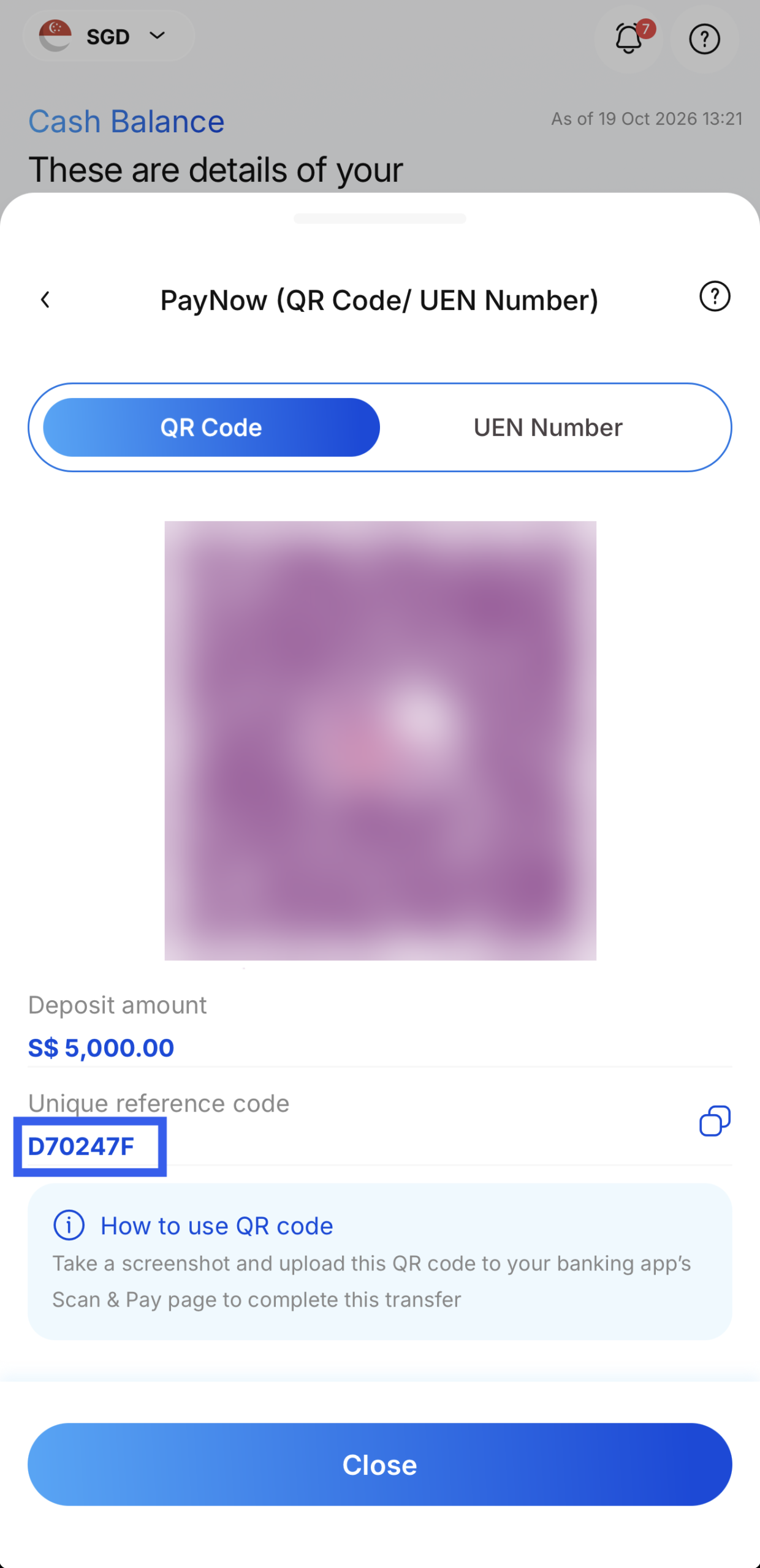
Step 4 — Deposit money. Transfer by PayNow or bank transfer from a bank account in your own name. Include the reference code shown in your app so the deposit is matched to your account.

Step 5 — Pick a Deal and invest. Read its factsheet, enter your amount and confirm. Your money is set aside until the deal starts, and you’ll receive an email when the investment begins.

💳 Deal terms and conditions change often, and it’s hard to keep up. That’s why I run a Telegram Broadcast with timely, bite-sized updates.
Audz, your lobang sis - sharing personal finance to achieve happiness, prosperity and progress for us all.