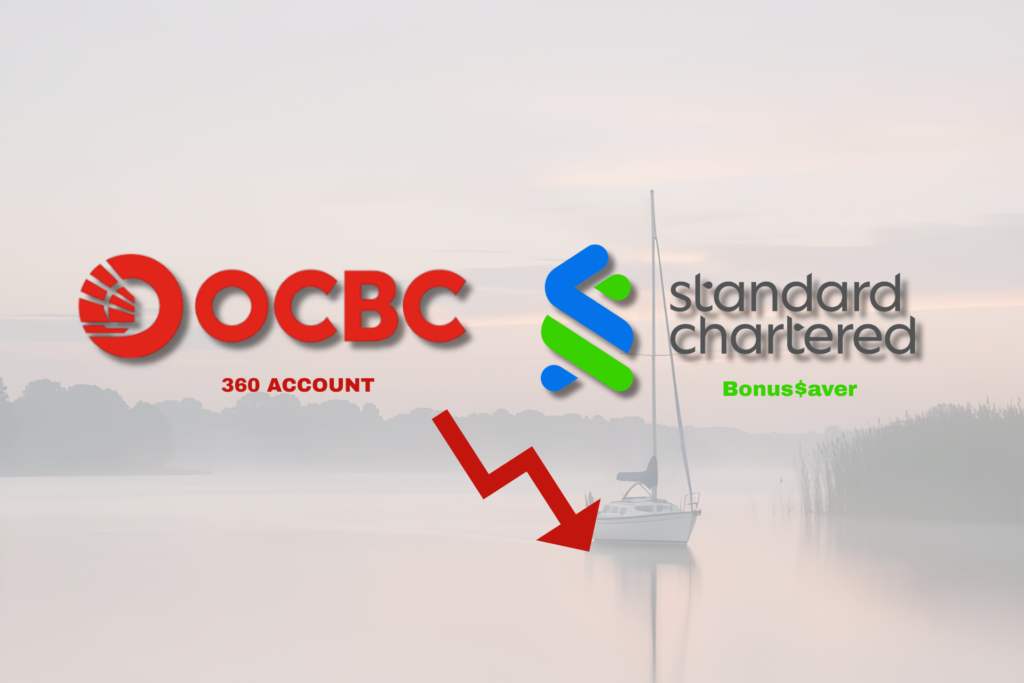
If you’ve been relying on high-yield savings accounts to grow your cash, there’s more bad news. Following recent revisions, both OCBC 360 and Standard Chartered Bonus$aver are cutting interest rates again from 1 May 2026—further reducing returns.
OCBC 360 Account: Interest Rates Reduced Again
What’s Changing
Here’s a quick breakdown of the key reductions:
Category
Tier
Before
After
Change
Base Interest
All balances
0.05%
0.05%
No change
Salary
First S$75K
1.2%
1.0%
↓ Reduced
Next S$25K
2.4%
2.0%
↓ Reduced
Save
First S$75K
0.4%
0.4%
No change
Next S$25K
0.8%
0.4%
↓ Reduced
Spend
First S$75K & Next S$25K
0.4%
0.25%
↓ Reduced
Insure(12 months)
First S$75K
1.2%
1.0%
↓ Reduced
Next S$25K
2.4%
2.0%
↓ Reduced
Invest(12 months)
First S$75K
1.2%
1.0%
↓ Reduced
Next S$25K
2.4%
2.0%
↓ Reduced
MAX EIR
5.45%
4.45%
↓ Reduced
What Can You Actually Expect to Earn?
To unlock the highest interest rate, you’ll need to credit at least S$1,800 salary, spend S$500 on eligible OCBC credit cards, grow your average daily balance by S$500, and purchase qualifying insurance and investment products.
But let’s be honest — most people just do the three basics: Salary + Save + Spend. If you’re not buying insurance or investment products through OCBC, your returns are a lot more straightforward. From 1 May 2026, sticking to these three categories gives you about 1.95% p.a., down from 2.45% previously — a 0.5% drop that adds up, especially if you’re parking close to S$100,000.
Standard Chartered Bonus$aver Account: Another Quiet Cut
It’s not just OCBC making moves. The Standard Chartered Bonus$aver Account is also seeing a fresh round of interest rate cuts from 1 May 2026, further reinforcing the broader downtrend across high-yield savings accounts.
Category
Before
After
Change
Base Interest
0.05%
0.05%
No change
Salary Credit
1.00%
0.90%
↓ Reduced
Card Spend
1.00%
0.90%
↓ Reduced
Invest (at least S$30,000; consecutive period of 6 months)
2.50%
1.50%
↓ Reduced
Insure (6 months)
2.50%
2.50%
No change
MAX EIR
5.85% (Realistic: 4.55%)
5.85% (Realistic: 3.35%)
↓ Reduced
Salary Credit and Card Spend see a slight dip from 1.00% to 0.90% p.a. each. The steepest cut is to the Invest category — down from 2.50% to 1.50% p.a. Insurance rates remain unchanged.
For a more practical way to assess whether the revised rates are still worth it, try plugging your numbers into this high-yield savings account calculator:
At this point, the direction is clear—high-yield savings accounts are no longer as rewarding as they once were. With both the OCBC 360 Account and Standard Chartered Bonus$aver cutting rates again, the gap between effort and reward continues to widen.
While these accounts can still offer decent returns compared to basic savings accounts, the reality is that you now have to jump through the same hoops for noticeably less interest. For many, especially those sticking to simple strategies like salary credit and card spend, returns have fallen closer to the ~1.95%–3.35% range—hardly “high-yield” by past standards.
That doesn’t mean you should abandon them entirely—but it does mean it’s time to re-evaluate your strategy. Whether that’s optimizing which conditions you fulfill, splitting funds across multiple accounts, or exploring alternative options, being passive is no longer enough.
💳 Credit cards change their T&Cs every so often and it is difficult to stay updated. That’s why I created a Telegram Broadcast where you can receive timely bite-sized updates to get the most out of your spending.
💡 We believe in always paying our credit card bills on time and in full. It is only by doing that, can we fully maximise our credit card benefits.
Purchases made through links in this article may generate an affiliate commission that helps keep this site running. Found this post useful? Subscribe to our Telegram Channel for more updates!
lobangsis
Audz, your lobang sis shares personal finance to achieve happiness, prosperity and progress for us all.
Get 22,000 HeyMax Miles or Dyson Airstrait™ straightener or Galaxy Buds 4 Pro + S$150 eCapitaVoucher or S$380 Cash via PayNow when you spend S$500 within 30 days of card approval
Get Dyson Airstrait or 22k Heymax Miles or Samsung Galaxy Buds4 Pro + S$180 eCapitaVoucher Bundle or S$400 Cash via PayNow when you spend S$400 within 30 days of card approval
Get Samsung Galaxy Buds4 Pro + S$160 eCapitaVoucher Bundle or Dyson Airstrait™ straightener or 22k HeyMax Miles or S$400 Cash via PayNow when you spend S$500 by the end of the following calendar month + provide marketing consent
Get 22,000 HeyMax Miles or Dyson Airstrait™ straightener or Galaxy Buds 4 Pro + S$150 eCapitaVoucher or S$380 Cash via PayNow when you spend S$500 within 30 days of card approval
Valid for new-to-bank credit cardholders or does not own any of the bank’s credit cards in the last 12 months, unless otherwise stated.
Gift confirmation are usually sent after you have completed rewards redemption form (sent to your email) & fulfilled qualifying spend within stipulated period.
Get 22,000 HeyMax Miles or Dyson Airstrait™ straightener or Galaxy Buds 4 Pro + S$150 eCapitaVoucher or S$380 Cash via PayNow when you spend S$500 within 30 days of card approval
Get Dyson Airstrait or 22k Heymax Miles or Samsung Galaxy Buds4 Pro + S$180 eCapitaVoucher Bundle or S$400 Cash via PayNow when you spend S$400 within 30 days of card approval
Get Samsung Galaxy Buds4 Pro + S$160 eCapitaVoucher Bundle or Dyson Airstrait™ straightener or 22k HeyMax Miles or S$400 Cash via PayNow when you spend S$500 by the end of the following calendar month + provide marketing consent
Get 22,000 HeyMax Miles or Dyson Airstrait™ straightener or Galaxy Buds 4 Pro + S$150 eCapitaVoucher or S$380 Cash via PayNow when you spend S$500 within 30 days of card approval
Get 1-year Disney+ Premium subscription (worth S$189.98) when you credit at least S$1,800 monthly salary to your account via GIRO or FAST/PayNow by the following month of account opening
OCBC 360 Account is a high-yield savings account that rewards you with bonus interest for crediting your salary, saving, and spending on OCBC cards. You can also purchase insurance or investment products. It’s ideal for working adults who can consistently meet these criteria to maximize their interest earnings.
Comes with 3 Main Requirements:
Salary Crediting: Your salary must be deposited from a corporate account with the purpose of payment being “SALARY” to qualify for the full interest rate.
Savings Increase: You need to increase your balance by S$500 monthly for bonus interest, with potential “resets” impacting your ROI. Check the OCBC app under “Money Insights” > “Total Balance” to see if you meet this criteria.
Spend S$500 a month on one of these OCBC Credit Cards: OCBC 365, OCBC Infinity Cashback, OCBC NXT, OCBC 90N or OCBC Rewards.
Standard Chartered Bonus$aver
Promo Details:
Get up to S$218 cashback (consists of S$188 welcome cashback + S$30 when you apply using my code: DBF6F) when you deposit and maintain S$50,000 in fresh funds.
How to qualify:
Apply for a Bonus$aver Account and Bonus$aver World Mastercard Credit Card (as main account/principal cardholder).
Deposit S$50,000 fresh funds.
Keep the deposit until the end of the calendar month after account opening.
Who can apply:
New Bonus$aver accountholders, or existing Standard Chartered customers who don’t have a Bonus$aver account yet.
Apply for a Standard Chartered credit card first if you are new to SC credit card holder (with sign-up bonus) before joining this promo. I personally recommend these two:
If you open the Bonus$aver Account + Bonus$aver World Mastercard first, you won’t be considered new-to-bank for other Standard Chartered credit card sign-up rewards.
Standard Chartered Bonus$aver
The Standard Chartered Bonus$aver Account offers up to 8.05% p.a. interest on the first S$$100,000 when you credit salary, spend on the linked card, and opt for investment or insurance products. Salary and card spend alone can earn around 3.05% p.a.
To Achieve 3.05% p.a. Interest:
Credit a salary of at least S$3,000/month via FAST, GIRO, or PayNow. There are no hacks for this at the moment.
Spend at least S$1,000/month on your linked Bonus$aver credit or debit card.
To Achieve an Additional 2.5% p.a. Interest:
You can do either below:
Subscribe, through SC, and settle a trade for an eligible unit trust with a minimum single subscription amount of S$20,000; OR
Trade a minimum of S$20,000 in cumulative buy trades for eligible Online Equities via SC Online Trading within a calendar month
Standard Chartered Simply Cash Card
Direct Bank Reward:
Get Samsonite MODUS Spinner 25” (worth S$610) and S$100 cashback when you spend S$800 within 60 days of your card approval
Get S$350 Cash via PayNow or S$370 Grab Voucher or Samsung Galaxy Buds4 Pro + S$100 eCapitaVoucher (worth S$449) when you spend a minimum of S$800 within 30 days of card approval and apply for one of the bonus products within 60 days of card approval (must apply via Singsaver):
EasyPay (can be applied directly (not via SingSaver) and will still be eligible if conditions are met)
Complete 3 retail credit card transactions of min. S$150 each (Min. tenure: 12 months
Bonus$aver Account
Open account with min. S$3,000 deposit
CashOne Personal Loan
Min. approved loan: S$1,000 (Min. tenure: 12 months)
Credit Card Funds Transfer (CCFT)
Min. approved amount: S$1,000 (Min. tenure: 3 months)
Note: After card approval, Singsaver will email you the link where you can apply for a bonus product, you MUST apply through that link only to secure the reward. Applying on the direct bank website will not be valid.
Promotion is valid for new to bank credit card holders
Must fulfill spending requirement to receive gift confirmation
Remember to check for SingSaver email and complete the registration to secure your reward!
Standard Chartered Simply Cash Card
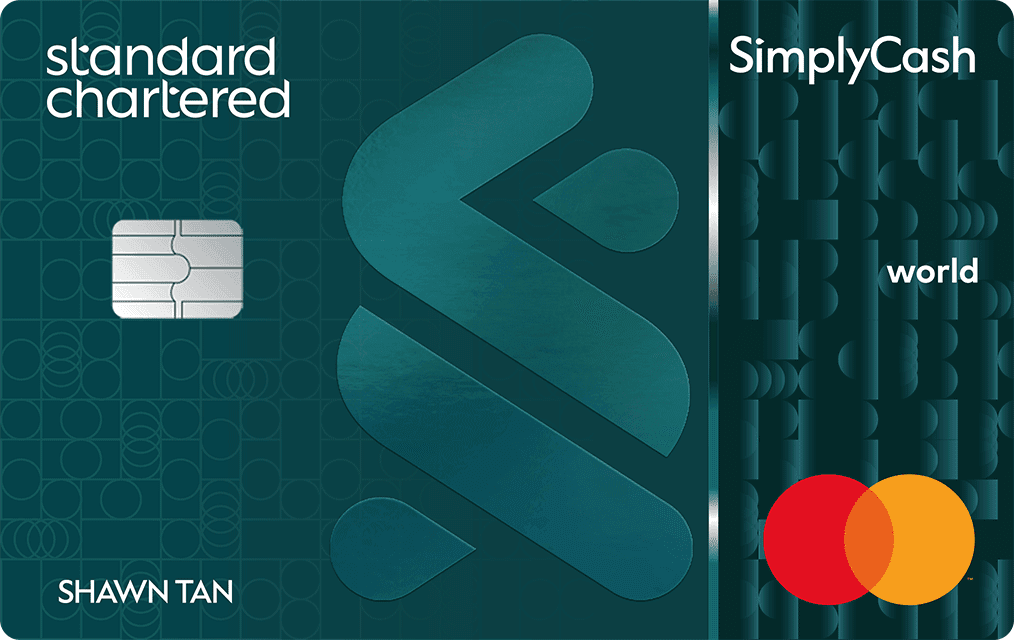
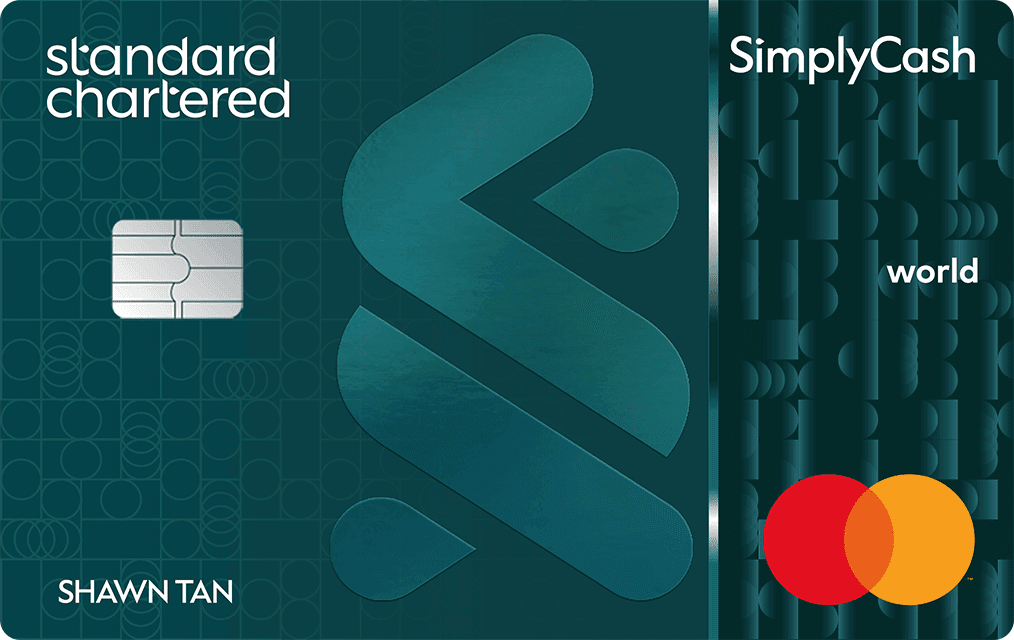
Earn a flat 1.5% cashback rate, with no minimum spend requirement, and no cashback cap. This card can be used in basically anything and everything spending! This can be an ultimate card to use when paying for wedding banquet venues!
Annual Fee
S$196.20 (including 9% GST), waived for the first two years
Income Requirement
S$30,000 (locals/PRs); S$60,000 (foreigners)
When is Cashback Credited
The cashback for your eligible spending per statement cycle will be credited into your Simply Cash Credit Card in the following statement month.
Get 12,000 Max Miles by HeyMax (worth a roundtrip to Kuala Lumpur with a travel value of S$210+) or Samsonite Straren Spinner 67/24 (worth S$600) or Apple Airpods 4 (without Active Noise Cancellation) (worth S$199) or S$180 Cash via PayNowwhen you spend S$800 within 60 days of card approval and apply for one of the bonus products within 60 days of card approval (must apply visa Singsaver):
EasyPay (can be applied directly (not via SingSaver) and will still be eligible if conditions are met)
Complete 3 retail credit card transactions of min. S$150 each (Min. tenure: 12 months
Bonus$aver Account
Open account with min. S$3,000 deposit
CashOne Personal Loan
Min. approved loan: S$1,000 (Min. tenure: 12 months)
Credit Card Funds Transfer (CCFT)
Min. approved amount: S$1,000 (Min. tenure: 3 months)
Note: After card approval, Singsaver will email you the link where you can apply for a bonus product, you MUST apply through that link only to secure the reward. Applying on the direct bank website will not be valid.
My thoughts: If you were going to apply for this card, you should choose the fee waiver option as the cost per mile is 196.20/10,000 miles = 1.96 cents per mile, which is quite expensive.
Standard Chartered Journey Card
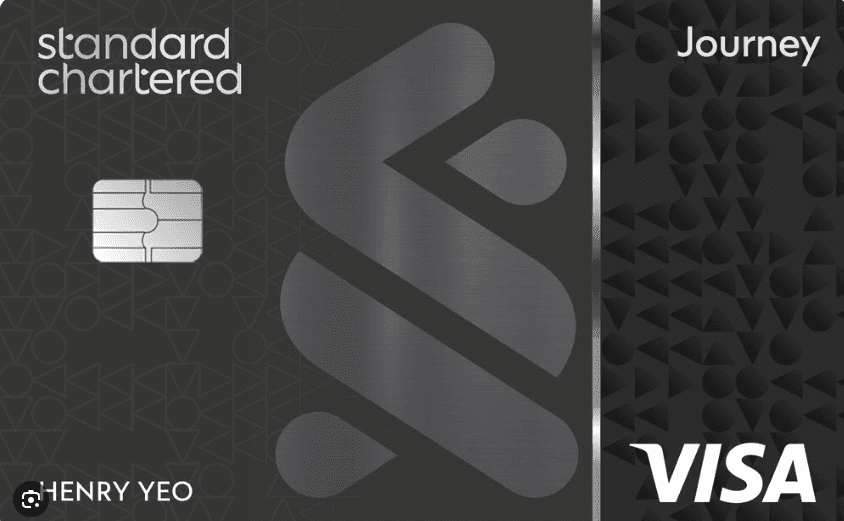
Earn up to 3 miles per dollar on selected bonus categories in SGD; 2 miles per dollar on overseas spending, and 1.2 miles per dollar on other local spending. All with no minimum monthly spending required. This card is best for those who spend a lot on the bonus online categories such as transportation, grocery and food delivery with a spending cap of S$1,000 per statement month
This comes with 2 complimentary airport lounge passes